Widespread School Takes the Stage at the European Parliament: A New Vision for European Education
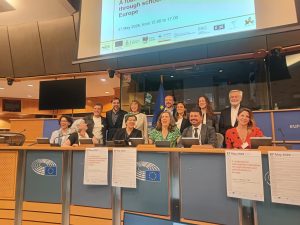
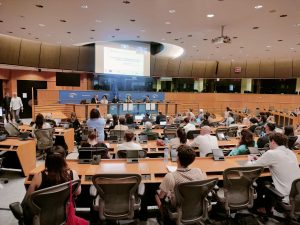
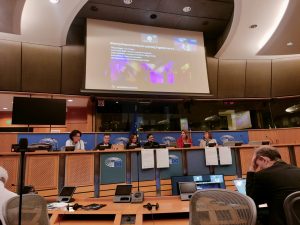
On Wednesday, May 27, the European Parliament hosted the final conference of the European project Widespread School. European policymakers, international experts, and researchers gathered in Brussels to present a transformative roadmap for educational innovation: Widespread Education.
The high-level event, hosted by MEP Annalisa Corrado and moderated by Laura Landi (UNIMORE), marked the culmination of a three-year Erasmus+ journey dedicated to breaking down classroom walls and embedding learning directly into local communities.
From Emergency Response to European Policy
The core of the presentation highlighted how an emergency solution born in Reggio Emilia during the COVID-19 pandemic transformed into a long-term pedagogical strategy. When schools lacked space, the municipality, schools, and cultural institutions collaborated to turn the city itself into a classroom—utilizing museums, libraries, parks, and theatres as active learning environments.
“We realized a fundamental truth: learning can happen everywhere, and education becomes infinitely stronger when school walls connect directly with the life of the community,” stated Marwa Mahmoud, Councilor for Education Policy for the City of Reggio Emilia, during her opening address. Mahmoud emphasized that Reggio Emilia backs this vision with heavy public investment, allocating a substantial portion of its municipal budget to community-rooted education.
The Core Policy Recommendations Presented
A pivotal moment of the conference was the presentation of official Policy Recommendations for an Education Beyond the Classroom, led by Claudio Dondi (Senior Educational Expert) and Benedetta Melloni (International Research Strategist) from Fondazione Reggio Children, alongside regional leader Alessio Mammi.
The framework presented to European stakeholders is built on four key policy pillars:
- The City as a Living Classroom: Shifting policies to look beyond traditional school walls. By converting civic spaces into active learning environments, cities can expand their educational capacity and make learning more contextual and meaningful.
- Shared Civic Responsibility: Framing education not as the sole duty of the school system, but as a collective responsibility. Successful policy requires a tight-knit alliance (an “educational ecosystem”) involving local municipalities, cultural institutions, universities, and families.
- High-Yield Public Investment: Emphasizing that systemic educational innovation requires heavy, deliberate municipal and regional backing to be sustainable.
- Cross-Border European Scalability: Demonstrating how this model successfully adapts across diverse European contexts, as proven by the pilot projects implemented in Italy (Reggio Emilia), Croatia (Zadar), Spain (Girona), and Finland (Espoo).
International contributors—including Tihana Magaš (Zadar), Jordi Collet-Sabé (UVic), Chiara Bertolini (UNIMORE), Aram Aflatuni (Gutsy Go), and Ulla Myllyniemi (SYKLI)—shared data proving that these community-rooted pilots noticeably increase student motivation, enhance well-being, and revitalize local civic fabrics.
A Call to Action for European Institutions
The conference concluded with a powerful message to European leaders, reinforced by Géraldine Libreau, Policy Officer at the European Commission (DG Education and Culture): local action alone is not enough.
While municipalities are highly effective at building these educational ecosystems on the ground, presenters closed the event with a direct call to action. They urged European institutions and national governments to officially recognize, fund, and integrate Widespread Education into long-term European educational strategies and future funding frameworks.
With the conclusion of this successful event, the Widespread School project sets a new benchmark for how European cities can collaborate to prepare younger generations for the complexities of tomorrow.